Mitsubishi E6 Error in Pasadena
The short answer: A Mitsubishi E6 error in Pasadena, CA (ZIP 91101 to 91107) means the indoor and outdoor units lost communication over the S1/S2/S3 wiring on a Mitsubishi Electric mini-split. Call (213) 444-4051 or book online and we trace the run from the head to the MUZ condenser.
Fast facts
- E6 = indoor-outdoor communication lost (the E6/E7 fault family).
- Carried on the 3-wire S1/S2/S3 interconnect between head and condenser.
- Top causes: loose or corroded terminal, nicked wire, miswire, surge, failed board.
- Wiring fix: often within a $79 to $200 visit. Board: about $400 to $2,000.
- One clean breaker reset can clear a surge-induced E6. Service 91101 to 91107.
What does the Mitsubishi E6 error mean?
E6 is a communication fault between the indoor head and the outdoor unit. On a Mitsubishi Electric mini-split, the two units are joined by a three-conductor interconnect - terminals S1, S2, and S3. S1 and S2 carry power; S3 carries the serial communication that lets the head and the condenser agree on mode, capacity, and fan speed many times a second. When that conversation drops out or gets garbled, the indoor board waits, times out, and posts E6 (the E6 and E7 codes are the two halves of the same handshake - one end reports it cannot hear the other). The system then stops, because a head and a condenser that cannot coordinate are not safe to run. The key thing to understand is that E6 is almost never a refrigerant or mechanical fault - it is electrical and signal, which is why the repair so often comes down to a single terminal or a single damaged wire rather than an expensive part.
Why do Pasadena mini-splits throw E6?
The wiring is where Pasadena's older homes bite. Running a clean S1/S2/S3 interconnect through a 1920s Craftsman in Bungalow Heaven or a Spanish revival in Madison Heights means pulling cable through plaster, knob-and-tube-era cavities, and unconditioned attics that swing from cold winter nights to baking Zone 9 afternoons against the foothills. That thermal cycling loosens terminal screws over a few seasons until a conductor backs out just far enough to break the signal. Attic humidity and the occasional roof leak corrode a splice green until it goes high-resistance. Remodels are the other culprit - a contractor restoring a Historic Highlands bungalow drives a staple or a nail through the low-voltage run, or a handyman reconnects S1, S2, and S3 in the wrong order after pulling the head to paint. And the grid plays a part: Santa Ana-season surges and summer brownouts scramble the handshake and can latch E6 with nothing physically wrong. The common thread is that the fault lives in the wire and the terminals, exactly where old houses and outside hands tend to disturb them.
How do you trace an E6 fault, step by step?
An E6 trace is methodical electrical work, head to condenser:
- Confirm the code and try one controlled reset - power off at the breaker for five minutes, restore it - to rule out a one-time surge latch before tearing into anything.
- Kill power and open both terminal blocks. Verify S1, S2, and S3 land on the matching terminals at the head and the MUZ; a swapped pair from past work throws E6 instantly.
- Check every terminal screw for tightness and every conductor for corrosion, nicks, or a staple strike. A backed-out screw or a green splice is the most common find.
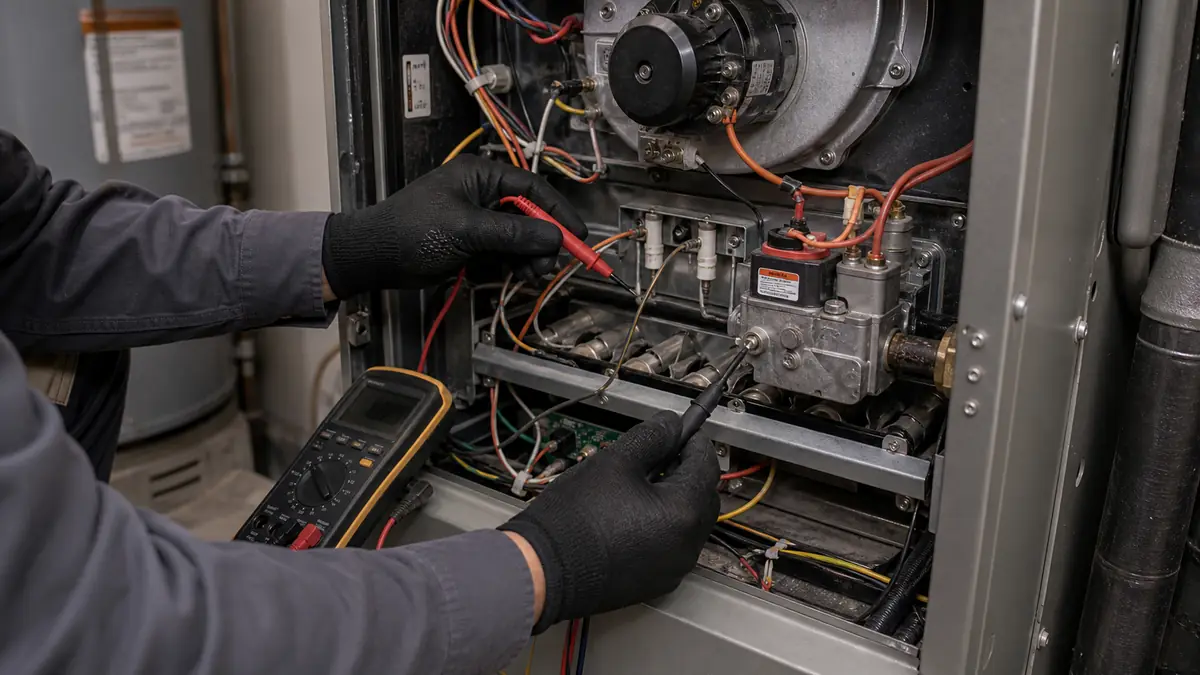
- With power restored, meter S1-to-S2 for the expected supply voltage and S2-to-S3 for the comm voltage. A dead or wandering S2-S3 reading isolates the fault to the wire run or a board.
- If the terminals and conductor test clean end to end, the fault is a control board - we determine whether the indoor or outdoor board lost its transceiver by swapping known signals before condemning a part.
- Inspect the run itself where it is reachable in the attic or wall chase for rodent damage and pinch points, common in these older homes.
What can a homeowner safely do about E6?
Your safe move is exactly one reset. Turn the system off at the breaker, wait five minutes, and switch it back on - a surge-induced E6 will often clear and stay gone. Confirm nothing obvious is wrong: the outdoor disconnect is on, no visible chewed wire, no water dripping on the condenser's electrical. Stop there. The S1/S2/S3 terminals sit alongside live line voltage inside both cabinets, and probing them or reseating a wire under power is a shock and damage risk that belongs to a tech with a meter. Do not start swapping the wire order to see what happens - a miswire can damage a board. If the single reset does not hold, the fault is physical and needs a proper trace, not repeated power-cycling that just hides a hardening connection.
What does an E6 repair cost here?
This is one of the friendlier codes on the bill, because the common cause is cheap to fix. A loose terminal, a corroded splice, a miswire, or a damaged length of low-voltage cable is usually corrected within a $79 to $200 service visit across 91101 to 91107 - the cost is the trip and the labor, plus a connector or a short pull of new wire. The expensive branch is a failed control board: an indoor or outdoor PCB runs about $400 to $2,000 installed depending on the model and which board carries the fault. Because the gap between those two numbers is so wide, we never lead with a board - we meter the wiring and the terminal voltages first and only condemn a board when the conductor tests clean. Whatever the path, we quote it before the work. The repair falls under Mitsubishi mini-split repair in Pasadena.
When should an E6 be treated as urgent?
E6 itself is a safe shutdown - the system stopped on purpose - so it is normally a same-week call rather than an after-hours scramble. Push it up the list when the loss of cooling matters: a heat-sensitive household during a Santa Ana spike past 100 F, or a code that flickers in and out and lets the unit start and stop repeatedly, which stresses the compressor with every restart. Also treat it as urgent if you find scorching, melted insulation, or a burnt smell at a terminal - that is a connection arcing, and it should be powered off at the breaker and looked at quickly. Short of those, leave the system off, note whether a single reset held, and book the diagnosis. Repeated resets on a real wiring fault only delay the fix and risk the board.
How E6 fits with the rest of the system
Because E6 stops the whole system, it can look like a dead unit or a no-heat call in Pasadena in winter or a no-cool call in summer - the giveaway is the code on the remote rather than a unit that runs but underperforms. If yours runs but cycles oddly instead of posting a fault, read short cycling. To compare E6 against the P and U faults and see the full code map, head back to the Mitsubishi error codes hub.
Common questions
What is a Mitsubishi E6 error?
E6 is an indoor-to-outdoor communication error - the wall head and the outdoor MUZ unit stopped exchanging the signal that keeps them in sync, so the system shuts down. It lives in the E6/E7 family. On a Pasadena mini-split the usual cause is the three-wire S1/S2/S3 interconnect: a loose terminal, a corroded or nicked conductor, or a miswire after someone worked on the unit. Less often it is a failed indoor or outdoor control board. Call (213) 444-4051 and we trace the run end to end.
Is E6 a wiring problem or a board problem?
Most of the time it is wiring, which is good news for the repair bill. The S1/S2/S3 conductors carry both power and the comm signal between the head and the condenser, so a backed-out terminal screw, a corroded splice in a damp attic, or a staple driven through the cable during a remodel will drop communication and throw E6. We always confirm the wiring and terminal voltages before condemning a board, because a board is a $400-to-$2,000 part and a terminal repair is a fraction of that.
Can a power surge cause a Mitsubishi E6?
Yes. A surge or a brownout - common during a Pasadena Santa Ana event or a summer grid sag - can scramble the handshake between the indoor and outdoor boards and latch E6 even when the wiring is fine. Sometimes a single clean power-cycle at the breaker clears a surge-induced E6 for good. If it comes right back, the fault is physical: a wire, a terminal, or a board that the surge actually damaged, and that needs a meter, not another reset.
How much does it cost to fix an E6 in Pasadena?
If it is the wiring or a terminal - the common case - the repair usually lands within a $79 to $200 service visit across 91101 to 91107, since the fix is labor and a connector, not a major part. If the diagnosis points at a failed indoor or outdoor control board, that part runs about $400 to $2,000 installed depending on the model and which board it is. We meter the wiring first and quote the exact path before any board goes in. Book online or call (213) 444-4051.