Mitsubishi P8 Code in Pasadena
The short answer: A Mitsubishi P8 code in Pasadena, CA (ZIP 91101 to 91107) means abnormal pipe temperature, most often a flare-joint refrigerant leak on a Mitsubishi Electric mini-split serving an old Bungalow Heaven Craftsman. Call (213) 444-4051 or book online and we leak-test the line set before recharging.
Fast facts
- P8 = abnormal pipe temperature read by the TH2 / TH5 pipe thermistors.
- Top Pasadena cause: a slow refrigerant leak at a flare joint on the line set.
- Other causes: stuck LEV/EEV metering valve, failed pipe sensor, low charge.
- Typical fix lane: $225 to $1,500; a sensor or valve sits at the low end.
- Do not top off a leaking system - find the leak first. Service 91101 to 91107.
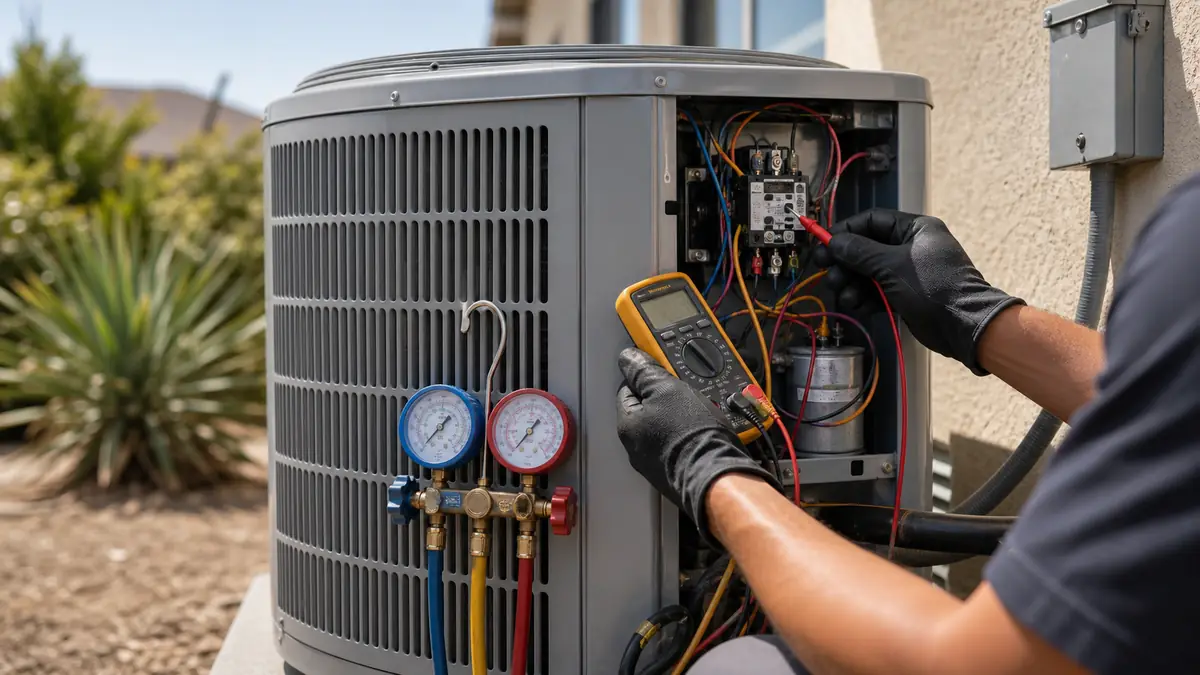
What does the Mitsubishi P8 code actually mean?
P8 is a pipe-temperature protection fault. A Mitsubishi Electric indoor unit watches two pipe thermistors - TH2 on the liquid line and TH5 on the gas line - and compares them against the room sensor and against each other. When that spread falls outside the window the firmware allows, the control reads it as a refrigerant-side problem and trips P8 to stop the compressor before it runs damaged. The code is not telling you which part broke; it is telling you the pipe temperatures are wrong. Nine times out of ten on a ductless retrofit, the reason they are wrong is that the system is low on refrigerant, and the reason it is low is a leak. The other paths - a stuck linear expansion valve metering the wrong amount, a pipe thermistor reading off its curve, or on some wall units an inter-unit signal issue mistaken for a pipe fault - are real but less common. That is why the diagnosis starts at the refrigerant circuit and works outward.
Why does P8 happen so often in Pasadena homes?
Pasadena's housing stock works against ductless line sets in a specific way. Bungalow Heaven Craftsmans, the Spanish and Mediterranean revivals around Madison Heights, and the Tudors of Historic Highlands were never built for refrigerant piping, so a mini-split retrofit means fishing the line set through old plaster, balloon-framed walls, and tight attics. Every one of those runs ends in flare joints, and flare joints are the number-one leak point on any ductless system - a flare cut a hair off-angle or torqued by feel in a cramped Linda Vista attic will seep slowly for a year before the charge drops far enough to throw P8. Then the climate finishes the job: Zone 9 foothill heat traps against the San Gabriels, the system runs long and hard from June through September, the line set sees its widest temperature swings, and a marginal joint that held all winter finally lets go. The estate-sized homes around here often run multi-zone systems with more joints and longer runs, which simply means more places for the same failure to start.
How do you diagnose a P8 on a Mitsubishi mini-split?
The diagnosis follows the refrigerant, with instruments, in order:
- Pull the fault history off the indoor board, MHK2, or kumo cloud and confirm it is P8, plus note any P6 freeze trips logged with it - a low charge often throws both.
- Check the obvious airflow first: filter and indoor coil, since a starved coil can skew pipe temperatures and mimic the early stage of the fault.
- Read the TH2 and TH5 pipe thermistors at the connector with a meter and compare each resistance to its temperature curve. A sensor reading wildly off its curve points at the thermistor, not the charge.
- Gauge the circuit and read superheat and subcool against the model's target. Low subcool with high superheat and a frosted liquid line is the classic low-charge signature behind P8.
- Leak-test to find where it is going: electronic sniffer and bubble solution at every flare, the service ports, and the LEV body. We pressure-test with nitrogen if a flare looks suspect but will not sniff under vacuum.
- If the charge and sensors check out, watch the LEV step open and close on command; a valve stuck part-open meters wrong and trips P8 with a correct charge.
What can I safely check myself before calling?
Two homeowner steps are safe and worth doing. Rinse or replace the indoor filter and look at the coil through the louvers - a choked coil can push pipe temperatures toward a fault. Then try exactly one power-cycle: kill the breaker for five minutes and restore it, in case P8 was a one-time glitch. Stop there. Everything past that point - opening the refrigerant circuit, connecting gauges, touching the flares, or adding refrigerant - requires EPA Section 608 certification and recovery equipment, and getting a flare torque or a charge weight wrong turns a small leak into a starved compressor. If P8 returns after the reset, it is a real refrigerant fault and a pro call, not a parts-store can of refrigerant.
What will it cost to fix a P8 in Pasadena?
The number depends on which path the diagnosis lands on. A failed pipe thermistor or a stuck LEV valve sits at the low end - the part is inexpensive and the labor is the bulk of it. A flare-joint leak is the common case: re-flare or replace the joint, pull a deep vacuum on the line set, and weigh in an exact R-410A charge. That runs roughly $225 to $1,500 depending on how much refrigerant leaked, how long the run is, and whether the leaking joint is behind plaster or up in an attic. The worst case is when a starved compressor was run on P8 for months and is now damaged, which pushes toward $1,200 to $3,500 and the point where the repair-or-replace math earns its keep. We quote the part before opening the circuit. The repair itself is covered under Mitsubishi mini-split repair in Pasadena.
When is a P8 urgent versus a same-week call?
P8 is usually a same-week diagnosis, not a 2 a.m. emergency - the unit has already shut itself down to protect the compressor. Make it urgent if the system keeps relighting and running on a hot Zone 9 afternoon despite the code, because a compressor cycling low on charge is wearing out fast; if you hear the outdoor unit straining or smell anything off; or if the home has someone who cannot ride out a no-cool stretch during a Santa Ana spike past 100 F. In those cases leave it off at the breaker and call rather than reset. A P8 that returns within minutes of a reset has a real leak and earns priority over routine work.
How a P8 ties into the rest of the system
A low charge behind P8 rarely travels alone. It often drags in a no-cool complaint on the hottest days and can throw freeze trips as the coil ices. If your unit is cycling on and off oddly rather than holding a fault, read short cycling in Pasadena instead. For the full slate of fault codes and how the P, E, and U families differ, go back to the Mitsubishi error codes hub.
Common questions
What does a P8 code mean on my Mitsubishi mini-split?
P8 means an abnormal pipe temperature - the indoor pipe thermistors (TH2 and TH5) read a temperature spread the unit considers impossible for normal operation, so it shuts down to protect the compressor. On a Pasadena ductless system the most common root cause is a refrigerant leak at a flare joint that left the charge low. Less often it is a stuck LEV metering valve, a failed pipe sensor, or a comm hiccup on certain wall units. Call (213) 444-4051 for a leak test, not a guess.
Can I just add refrigerant to clear a P8?
No, and you should not. Refrigerant does not get used up - if the charge is low, it leaked out, and a top-off only buys a few weeks before P8 returns and the compressor runs starved again. The right fix is to find the leak (usually a flare joint), repair it, evacuate the line set, and weigh in an exact R-410A charge. Topping off a leaking Mitsubishi system also wastes refrigerant that EPA rules say a certified tech must recover, not vent.
Is a P8 code dangerous to keep running?
It is hard on the equipment, not on you. A unit cycling on P8 is running low on refrigerant, which lets the compressor overheat and run with poor lubrication - the fastest way to turn a $400 leak repair into a $1,500-plus compressor or inverter job. The system usually locks itself out before real damage, but repeated resets defeat that protection. If P8 keeps returning, shut the unit off at the breaker and book a diagnosis rather than nursing it through the Pasadena summer.
How much does a P8 repair cost in Pasadena?
A flare-joint leak repair plus a weighed recharge typically runs $225 to $1,500 across 91101 to 91107, depending on how much R-410A leaked out and how buried the joint is in wall or attic. A stuck LEV valve or a failed pipe thermistor sits at the lower end of that range. We leak-test and quote the exact part and labor before opening the circuit, and the diagnostic fee credits toward the repair. Book online or call (213) 444-4051.